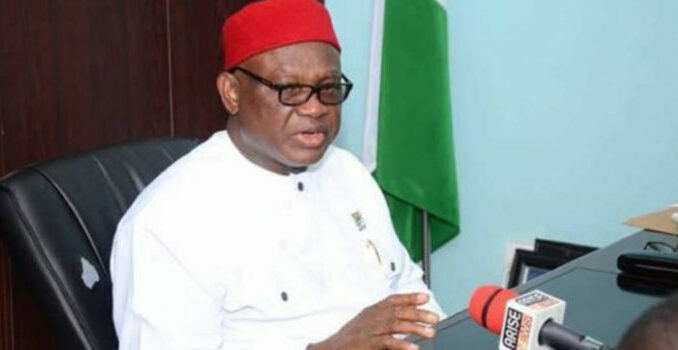
Chief Chekwas Okorie, pioneer National Chairman of the All Progressives Grand Alliance (APGA) and President of Igbo Agenda Dialogue, has expressed confidence that Peter Obi will receive significantly more votes from Igbo voters in Lagos State during the 2027 presidential election than he did in 2023.
Okorie, who made the prediction while speaking with journalists in Abuja on Wednesday, said the number of Igbo voters expected to support Obi in Lagos could be twice the figure recorded in the last general election.
The discussion covered the position of Igbo Agenda Dialogue on comments attributed to Anambra State Governor Chukwuma Soludo concerning Obi, claims that Northerners would not support an Igbo presidential candidate, and the political stance of the Minister of the Federal Capital Territory, Nyesom Wike, who has declared support for President Bola Tinubu in Rivers State and the FCT.
Addressing Soludo’s position, Okorie recalled that both the Anambra governor and Obi emerged from the APGA political platform, arguing that their shared political history should be considered in discussions surrounding the forthcoming elections.
He also cited the Osun State governorship election as an example of voters asserting their preferences despite the influence of powerful political figures.
According to him, even with the alleged involvement of more than 30 governors, including the President of the Senate, voters in Osun still demonstrated their ability to choose their preferred candidate.
Okorie further pointed to the decision of the victorious Accord Party candidate, Senator Ademola Adeleke, to support Tinubu’s re-election bid, despite the political circumstances surrounding the Osun election.
He questioned why Soludo would not learn from such political developments, particularly given that the Anambra governor was reportedly the first governor to endorse Tinubu for re-election.
“We therefore wonder why Professor Soludo would not take a cue from that example.
If you recall, Professor Soludo was the first governor to endorse President Tinubu, even before governors elected on the platform of the APC did so,” he added.
The Igbo leader suggested that Soludo’s current position might be influenced by a personal disagreement, adding that his organisation would not allow the issue to distract it from its broader political objectives.
“We believe his current position is driven by a personal grievance. Consequently, we do not intend to waste our time engaging him further because the task before us is far greater than any individual.
“My advice to him is to be mindful of the remaining three and a half years of his tenure. If Peter Obi’s party sweeps the Anambra State House of Assembly election, Soludo could find himself dealing with a hostile legislature for the remainder of his administration. That should be his concern.
As for the presidential election in Anambra State, let us see whether he can deliver even 10 per cent of the state’s votes to President Tinubu.
“In the 2023 presidential election, Tinubu secured only 5.3 per cent of the votes cast in the South-east. We will see whether Soludo can increase that figure to 10 per cent.”
On the argument that Northerners would not vote for an Igbo presidential candidate, Okorie dismissed such assertions as campaign-season rhetoric, insisting that Nigeria’s political history provides examples of support across ethnic lines.
“I would say that such sentiments often emerge during election campaigns.
“Some of those making these statements may not have sufficient knowledge of Nigeria’s political history. That is why we have taken the time to highlight some historical developments that many people may not know about.
“During the First Republic, the NCNC secured the highest number of votes among the political parties that contested the elections, followed by the NPC. The Action Group also secured its own share of votes and seats.
“If Dr Nnamdi Azikiwe had entered into a coalition with Chief Obafemi Awolowo, they could still have formed a government, with Azikiwe emerging as Prime Minister because his party would have been the senior partner in that arrangement.
However, Azikiwe chose to prioritise Nigeria’s stability.
“The political leaders of that period believed that a united and larger Nigeria would be better for the country.
“How many people know that, as far back as 1960, an individual of Fulani origin was able to secure electoral support in Enugu, despite the relatively small Fulani population in the area at the time?
“Igbo voters supported and elected him. When his party subsequently declined to nominate him, reportedly because of the embarrassment surrounding the situation, the same Igbo voters returned him to office for a second term as an independent candidate. Where else has such a thing happened in Nigeria?
“Those who make derogatory statements about Igbo presidential aspirations may be people who were born much later and whose leaders have failed to educate them about the country’s political history.”
Okorie maintained that voting decisions should not be determined by ethnic identity, arguing that historical examples demonstrate the possibility of political cooperation among Nigerians from different backgrounds.
He also criticised Wike’s political position, placing the FCT minister in the same category as Soludo in terms of what he described as distractions from the wider political task ahead.
“Furthermore, he placed the FCT Minister, Wike in the same category as Governor Soludo, adding, “We do not intend to allow them to distract us from the task ahead.
“However, I would like to draw attention to what happened in the FCT during the 2023 presidential election. At that time, political consciousness and mobilisation were not as pronounced as they are today. Yet Peter Obi won approximately 58 per cent of the votes cast in the FCT, leaving about 42 per cent to be shared between Atiku Abubakar and Bola Tinubu.
Neither of the other two candidates secured the 25 per cent threshold in the FCT. The matter was also tested in court.
Regarding Rivers State, Peter Obi did not have an established political structure comparable to those of the major parties at the time. Yet Wike is now suggesting that he was instrumental in securing Tinubu’s victory in Rivers State. In effect, Wike is claiming responsibility for Tinubu’s electoral success in the state.
“This raises questions about the extent to which the outcome reflected the preferences of Rivers voters and the influence of political actors.
“Our message to Igbo voters is simple: they should not stay at home on election day. They should go out and vote.
“I am confident that the number of Igbo people who will vote in Lagos in 2027 will be twice the number who voted in 2023.
We have arrangements for reaching out to these communities and engaging them directly.”
Okorie’s remarks underline his organisation’s intention to mobilise Igbo voters ahead of the 2027 general elections, particularly in Lagos, while challenging claims that ethnic considerations would prevent an Igbo candidate from attracting support outside the South-East.
His prediction of a significant increase in Obi’s votes in Lagos, however, remains a political forecast ahead of the election, with the eventual outcome depending on voter participation, campaign mobilisation and the choices Nigerians make at the ballot box.
Leave a Reply