By Divine Sam
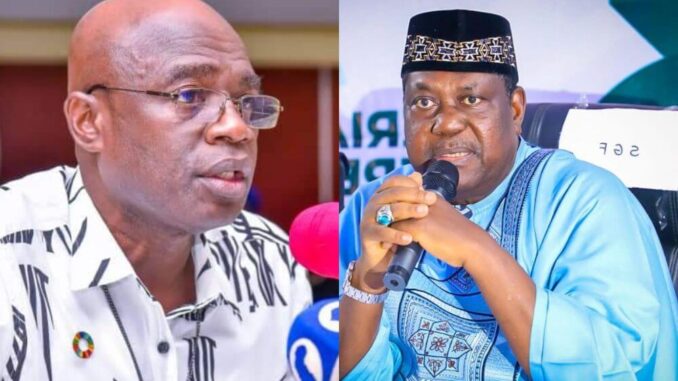
Efforts to resolve the lingering leadership crisis within the All Progressives Congress (APC) in Benue State have hit another setback after rival factions loyal to Governor Hyacinth Alia and the Secretary to the Government of the Federation (SGF), George Akume, failed to reach a peace agreement.
The latest development has raised concerns about the ruling party’s unity and preparedness for the 2027 general elections, despite renewed efforts by the APC national leadership to reconcile the warring camps.
The dispute centres on the leadership of the party’s state chapter, with both factions laying claim to the chairmanship position. While the governor’s camp recognises Benjamin Omale as the state chairman, the Akume-backed group insists that Austin Agada remains the legitimate chairman.
The disagreement has led to the emergence of parallel party secretariats in Makurdi, alongside a series of suspensions and counter-suspensions by the rival groups.
A reconciliation meeting convened by the APC national secretariat to address internal disputes across the country was expected to produce a breakthrough. However, the meeting reportedly ended without an agreement, as neither side was willing to abandon its position on the disputed leadership.
A party source familiar with the discussions said the disagreement extended beyond the chairmanship dispute to the struggle for control of the party’s structure ahead of the next general elections.
“The national delegation met with both sides separately. The issue is beyond chairmanship; it is about control of the party structure ahead of 2027. Neither Alia nor Akume is willing to concede,” the source said.
The governor’s faction reportedly wants the national leadership to recognise the Omale-led executive and undertake a fresh harmonisation of party structures at the ward level.
However, the Agada-led camp maintains that the party must respect the 2022 congress that produced Agada as chairman.
Alia’s faction insists on reconciliation
Benedict Yawe, publicity secretary of the Benjamin Omale-led faction, said his group remained committed to resolving the dispute through dialogue and mutual understanding.
He maintained that reconciliation was essential to the party’s unity, growth and electoral success in Benue State.
“Our position has always been clear, reconciliation is not only possible, it is necessary for the growth, unity, and electoral success of the All Progressives Congress, APC, in Benue State. As a party, we must rise above personal differences and recognize that our collective interest is far greater than the ambitions of any individual or group,” Yawe said.
He expressed confidence in his faction’s position, citing its grassroots support, established party structure and commitment to democratic principles.
Yawe, however, stressed that the group’s confidence should not be interpreted as hostility towards opposing members or an unwillingness to compromise.
He said the faction remained open to genuine dialogue and an inclusive settlement that would prioritise the future of the APC over individual interests.
According to him, any reconciliation process must respect the party’s constitution, established structures and legitimate leadership rather than impose the interests of one group on another.
He called on stakeholders to approach the discussions with an open mind and a willingness to make concessions in the collective interest of the party.
Akume’s camp accuses Alia of frustrating peace efforts
Meanwhile, Morgan Ihomun, publicity secretary of the Austin Agada-led faction, rejected suggestions that his group was responsible for the failure of the reconciliation initiative.
Instead, he accused Governor Alia of failing to make genuine efforts to reunite party members, despite the reported intervention of President Bola Tinubu.
“Governor Hyacinth Alia has refused to genuinely reconcile the party despite the intervention of President Bola Tinubu. Instead of embracing reconciliation, he has continued to grandstand and insult critical stakeholders of the party, referring to them as ‘Jija Bokoti’ (expired buckets),” Ihomun said.
He further alleged that the governor had failed to build strong relationships with key party stakeholders since assuming office, claiming that Alia had not held a meeting with APC members of the National Assembly elected from the state.
Ihomun accused the governor of adopting a leadership approach that had deepened divisions and weakened trust among party members.
He argued that resolving the crisis would require sincerity, mutual respect and recognition of legitimate party structures, rather than blame-shifting or intimidation.
Despite the disagreement, Ihomun reaffirmed his faction’s support for President Tinubu and said members were working towards the President’s re-election in 2027.
2027 elections raise stakes for APC
The unresolved dispute has sparked concerns among political observers that the internal division could weaken the APC’s electoral prospects in Benue State as the 2027 general elections approach.
Opposition parties, including the Peoples Democratic Party (PDP), could seek to capitalise on the crisis if the ruling party fails to resolve its differences and present a united front.
The disagreement has also placed pressure on the APC national leadership, with concerns that maintaining two competing party structures could create confusion among members at the grassroots and affect mobilisation ahead of the elections.
There are indications that the national leadership could consider a political settlement or establish a caretaker committee if the rival factions fail to agree on a unified structure in the coming weeks.
For now, both camps continue to operate independently, issuing separate statements and mobilising their supporters as the struggle for control of the party in Benue persists.
With the 2027 elections drawing closer, the challenge before the APC leadership is to find a lasting solution that can bring the factions together and prevent the prolonged dispute from undermining the party’s position in the state.
Leave a Reply